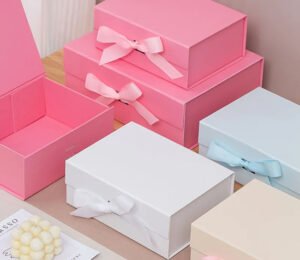
E-commerce brands face a simple question at the start of every packaging project: should the product ship in a mailer box or a folding carton? The two boxes look similar at first glance — both are made from paper and both carry a printed brand. Yet they serve very different jobs.
A mailer box protects a product through the post. A folding carton presents a product on a shelf. Choose the wrong one, and you pay for it — in damaged goods, in wasted material, or in a dull first impression. This guide compares them side by side and gives you five questions that lead to the right choice.
What Is a Mailer Box?
A mailer box is a shipping box made from corrugated board. It folds from a single die-cut sheet and locks shut without tape in most designs. The corrugated layer — a wavy sheet of paper glued between two flat liners — gives the box its strength and absorbs shocks during transit.
As a result, a mailer box can travel on its own, with no outer shipping carton. Most e-commerce brands use it as the only box between the warehouse and the customer. Corrugated mailer boxes work best for products that ship direct to the buyer — subscription boxes, apparel, cosmetics sets, and small electronics.

The inside of the lid prints well, so brands often add a message, a pattern, or a discount code there. Many direct-to-consumer brands treat the mailer box as part of the product experience, not just as protection.
However, a mailer box is heavier than a folding carton, and it costs more per unit at small sizes. For lightweight retail products that never travel alone, that extra strength is money spent on protection you do not need. Board grade matters too: E flute gives a smoother print surface, while B and C flute give more cushioning. Our corrugated flute guide explains the difference in detail.
What Is a Folding Carton?
A folding carton is a retail box made from paperboard — a single thick sheet of paper, usually between 300 and 500 gsm. It folds into a box with tuck-in flaps at each end. You see them everywhere: cereal boxes, cosmetic boxes, medicine boxes, and toy boxes.
Their strength is print quality. The smooth paperboard surface takes sharp graphics, fine text, and premium finishes such as foil stamping and spot UV. That makes the folding carton the first choice when the box must sell the product on a shelf.

The weakness is protection. A folding carton on its own cannot survive a courier network — it crushes, dents, and tears under stacking weight. For that reason, folding cartons almost always ship inside a larger outer carton.
In short, a folding carton is a display box first and a shipping box second — if at all. If your product reaches customers only through stores, it is often the best and cheapest choice.
Mailer Box vs Folding Carton at a Glance
A mailer box wins on protection. A folding carton wins on shelf appeal. Your product and your sales channel decide which matters more.
| Feature | Mailer Box | Folding Carton |
|---|---|---|
| Material | Corrugated board (E, B or C flute) | Paperboard (300–500 gsm) |
| Main job | Shipping and unboxing | Retail display |
| Protection | High — ships on its own | Low — needs an outer carton |
| Print quality | Good; best with E flute | Excellent — sharp and detailed |
| Best for | E-commerce, subscriptions | Retail shelves, gift sets |
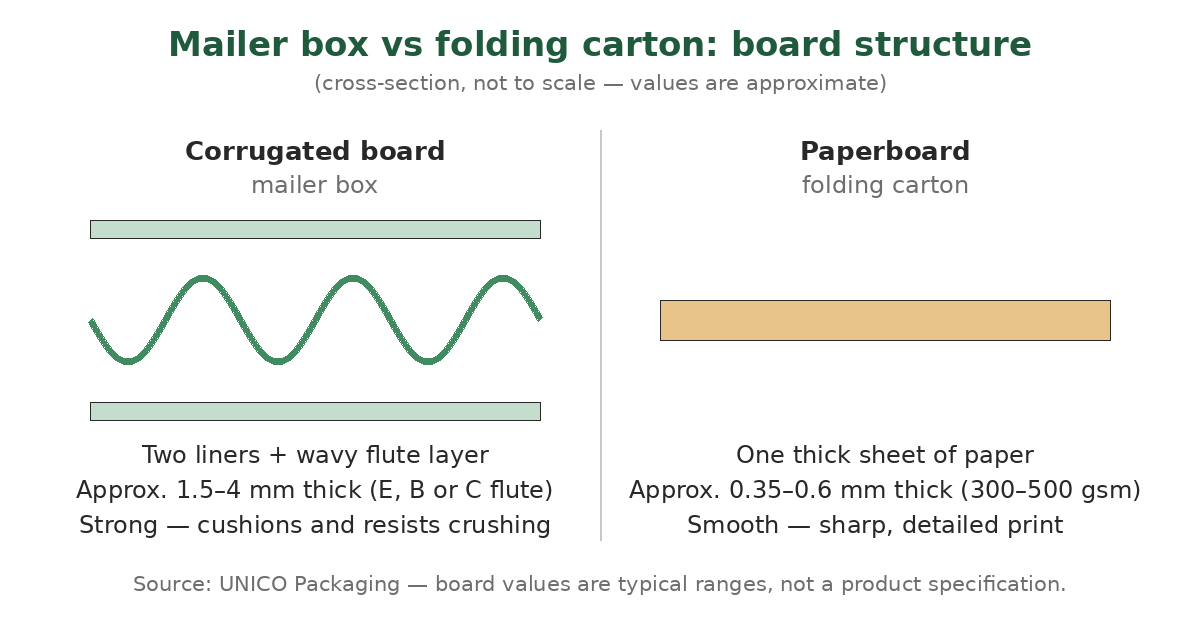
The fluted layer acts like a cushion. Paperboard has no such layer, so it stays thin and smooth — perfect for print, poor for impact.
How to Choose: Five Questions to Ask
1. How does the product reach the customer?
If the product ships direct to the buyer, start with a mailer box. It is the shipping box and the brand box in one. If the product goes to a store shelf, start with a folding carton, then add a plain outer carton for transport. When a product uses both channels, the channel with the larger volume usually sets the choice.
2. How heavy or fragile is the product?
Heavy or fragile products need corrugated protection. Glass bottles, ceramics, and electronics travel best in a mailer box with an insert. Light, sturdy products such as sachets or small accessories fit a folding carton with ease. When in doubt, test the real product in the real box — a drop test tells you more than any specification sheet.
3. Where does the customer first see the box?
On a shelf, print quality decides the sale. A folding carton shows your brand at its best, with crisp images and fine detail. At a front door, the unboxing decides the memory. A printed mailer box turns delivery into a brand moment.
4. What does the total cost look like?
Compare the full system, not one box. A folding carton looks cheaper per unit, yet it needs an outer shipping carton, filler, and extra packing labour. A mailer box costs more per unit but often needs nothing else. At low volumes, the mailer box can win on total cost. Always ask for a quote on the full system, including inserts and outer cartons, before you compare prices.
5. What are your sustainability goals?
Both boxes can use recycled and FSC-certified board. A mailer box uses more material per unit but replaces two boxes with one. A folding carton uses less material but needs a second box for shipping. Ask your supplier for the board source and the recyclability of any coating. A simple kraft finish with water-based print is often the easiest to recycle.
Can You Use Both Boxes Together?
Many brands use both: the folding carton presents the product, and the mailer box ships it. A skincare brand, for example, packs a serum bottle in a printed folding carton, then places that carton inside a mailer box with tissue paper.
The customer enjoys two unboxing moments: the mailer box first, then the retail box. This system costs more than one box alone, yet for premium products the extra cost often pays for itself in perceived value.
Common Mistakes Buyers Make
The most common mistake is choosing on looks alone. A beautiful folding carton that arrives crushed helps no one — test the box on your real delivery route before you order in volume.
A second mistake is skipping samples. Board grade, print colour, and flap fit all change between the screen and the real box. Order a physical sample first — custom samples typically take 3–5 days.
A third mistake is forgetting the insert. A loose product inside a strong box still breaks, so plan the insert with the box, not after it.
A Worked Example: Two Brands, Two Answers
Consider two brands with a similar product: a set of three scented candles. Brand A sells through its own online store, and each order ships direct to a home. A printed E flute mailer box with a simple insert is the right call. It protects the glass, carries the brand, and needs no outer carton.
Brand B sells the same candles through gift shops, where the box sits on a shelf next to ten rivals. A folding carton with foil stamping and a clean design wins the sale, and it ships to shops inside a plain master carton. Same product, different channel, different box. The channel decides.
Frequently Asked Questions
Can a mailer box work for retail shelves too?
Yes, in some cases. A small, neatly printed mailer box can sit on a shelf, yet a folding carton usually looks sharper and costs less for retail-only products. Use a mailer box for retail only when the same box also ships direct to customers.
Can a folding carton ship direct to customers?
Only inside an outer shipping carton. A folding carton alone will crush in transit, so budget for the outer carton and the filler as part of the total cost.
Which option is more sustainable?
Neither wins on its own. A mailer box can replace two boxes with one, while a folding carton uses less board per box. The real answer depends on board source, coating, and how much your customer can recycle. Ask for FSC-certified board and water-based coatings where possible.
Request a Custom Quote
Still unsure which box fits your product? Tell us about your product, your sales channel, and your order volume. We will help you compare both boxes side by side — and send a custom sample so you can judge the real box in your hands. We hold ISO 9001, ISO 14001, FSC, SGS and BSCI certification. Custom samples take 3–5 days, and mass production takes 12–15 days after artwork approval.
Request a custom quote today, and let us help you choose the box your product deserves.

Nick Zhang — Packaging Engineer
Nick Zhang is the packaging engineer behind the UNICO Packing blog. He has spent over 20 years in printing and packaging and knows the craft inside out — paper and board selection, offset printing, color management, lamination, foil stamping and die-cutting. Nick is strict about quality: he controls color difference and checks material quality batch by batch, and no box leaves the factory until it meets his standard. Here he shares his hands-on experience to help buyers make packaging decisions.