If you have ever ordered a custom corrugated box, you have probably been asked a deceptively simple question: which flute do you want? B, C, or E? The answer affects how well your product survives shipping, how sharply your artwork prints, and how much you pay per unit.
This guide explains the three most common corrugated flute profiles in plain terms, compares them side by side, and gives you a clear framework for choosing the right one.
What Is Corrugated Flute, Exactly?
A corrugated board is not a single sheet of cardboard. It is a sandwich: two flat linerboards with a wavy layer of paper, called the fluting medium, glued between them. That wave is the flute.
The flute does two jobs at once: its air space cushions your product and resists crushing, and it gives the board stiffness so a box holds its shape when stacked and shipped. Taller, wider waves generally cushion better and stack stronger. Shorter, tighter waves give a flatter, smoother surface that prints better and takes up less space. That trade-off is the whole story of B, C, and E flute.
B Flute: Strong, Compact, and Print-Friendly
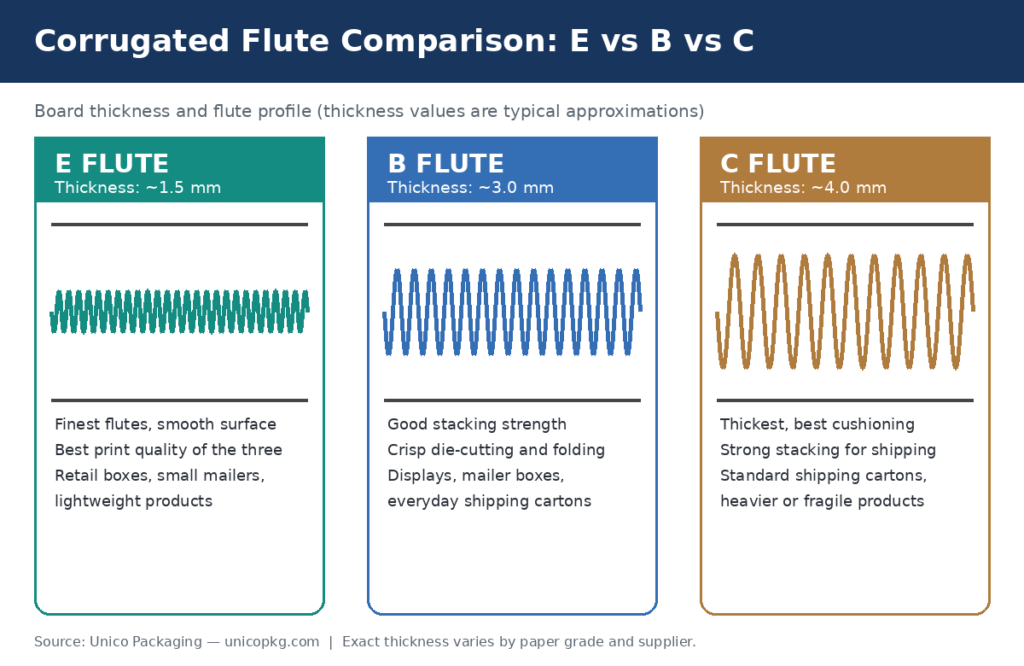
B flute is the workhorse of retail and food packaging. Its short, closely spaced waves produce a board roughly 3 mm thick. That compact profile offers good crush resistance for its thickness, prints cleanly — logos, product photography, and fine text reproduce well — and saves space, with more boxes per pallet and lower freight volume.
B flute is a strong default for canned goods, bottled products, counter displays, and die-cut retail packaging. Its main limitation is cushioning: for fragile or heavy items shipped alone, it may need extra inner protection such as dividers or inserts.
C Flute: The All-Rounder for Shipping
C flute is the most widely used flute profile in the world. At around 4 mm thick, it balances cushioning, stacking strength, and printability. If your box will travel through parcel networks and be stacked several layers high, C flute is usually the safest starting point: its taller waves absorb shocks better than B flute and handle vertical stacking loads well.
C flute is the standard choice for e-commerce shipping boxes and general-purpose mailer boxes. It prints acceptably for most shipping applications, although very fine detail will not be quite as crisp as on B or E flute. The trade-off is bulk: for lightweight products that do not need heavy cushioning, you may be paying for protection you do not use. See Unico’s corrugated boxes range.
E Flute: Thin, Premium, and Shelf-Ready
E flute is the thinnest of the three, at roughly 1.5 mm. Its very fine, tightly packed waves create an exceptionally smooth surface, close to the finish of a folding carton, making it the go-to profile when presentation matters as much as protection. It is common in premium retail, cosmetic, and electronics packaging, where it folds neatly, die-cuts cleanly, and feels more refined than a standard shipping box.
The limitation is strength. E flute alone is not designed for heavy products or rough long-distance shipping without an outer shipping carton: it is retail packaging first, best protected inside a sturdier outer box during transit.
B vs C vs E Flute at a Glance
| Feature | B Flute | C Flute | E Flute |
| Board thickness | ~3 mm | ~4 mm | ~1.5 mm |
| Cushioning | Good | Better | Limited |
| Stacking strength | Good | Very good | Moderate |
| Print quality | Very good | Good | Excellent |
| Best for | Retail, food, displays | Shipping, e-commerce | Premium retail, cosmetics |
| Watch out for | Less shock absorption | Bulkier, heavier | Not for heavy shipping alone |
These are typical industry ranges. Linerboard weight and manufacturing quality also affect performance, so confirm specifications with your supplier and test a physical sample before a large order.
How to Choose: Five Questions to Ask
1. How heavy and fragile is your product?
Heavy or fragile products need cushioning and stacking strength first, which points toward C flute, or double-wall board for the heaviest loads. Lightweight, durable products — apparel, books, stationery — often do fine in B flute, and premium lightweight goods may suit E flute.
2. Will the box ship alone or inside another carton?
A box that ships on its own must survive handling, drops, and stacking, which favors C flute. A retail box that travels inside a master shipping carton can prioritize print quality instead, favoring B or E flute.
3. How important is print quality?
If your box is your billboard — on a store shelf or in an unboxing video — surface smoothness matters. E flute gives the sharpest print, B flute is close behind, and C flute suits bold shipping graphics but less fine detail. Compare the options alongside Unico’s folding carton boxes.

4. What are your freight and storage constraints?
Thinner board stacks tighter and ships more efficiently. If you ship internationally or store large quantities, the space saving from B or E flute can add up — but weigh it against the cost of damage if a thinner board fails in transit.
5. What does your sustainability goal require?
All three profiles can be made from recycled and recyclable paperboard. The most sustainable choice is usually the lightest board that still protects your product reliably, because over-packaging wastes material and freight.

Common Mistakes Buyers Make
The most common mistake is choosing on price alone. A cheaper, thinner board that leads to crushed corners and replacement shipments is not cheaper at all. Test samples under realistic conditions — stack them, drop them, and ship them through your actual logistics route — before approving mass production.
A second mistake is confusing flute with board grade. Two C flute boxes can perform very differently depending on linerboard weight, so always specify both the flute profile and the board grade.
A third mistake is over-specifying. Using double-wall board for a lightweight T-shirt wastes money and material. Match the board to the job, not to an imagined worst case.
A Worked Example: Two Brands, Two Different Answers
Consider two brands ordering similar-sized boxes. Brand A sells bottled skincare serum: glass bottles, moderately heavy, shipped individually to customers. It needs cushioning and stacking strength, so C flute is the natural choice, with protective inserts inside.
Brand B sells a premium candle set in gift shops. The set is lightweight, the box is the retail display, and it ships to retailers in master cartons. It needs sharp print and a refined feel, so E flute wins — and because the retail box never ships alone, its lower shipping strength is irrelevant.
Same box size, different answers. The product, the channel, and the journey decide the flute, not habit.
Working With a Supplier: What to Confirm
When you request a quote, give your supplier what actually determines the recommendation: product dimensions and weight, fragility, shipping method, whether the box ships alone, and print requirements. Ask for physical samples in your chosen flute before approving artwork.
At Unico, custom samples are typically ready in 3–5 days, and mass production takes 12–15 days after artwork approval. The team has 150+ workers, most with 5+ years of experience, and holds ISO 9001, ISO 14001, FSC, SGS, and BSCI certifications. Every order is 100% customized. Browse the full product range.
Frequently Asked Questions
Can I combine flutes in one box?
Yes. Double-wall board commonly combines two flutes, such as B and C, to balance puncture resistance and cushioning. It suits heavy or high-value products, although it adds thickness and cost.
Does flute affect printing cost?
Indirectly, yes. Smoother boards (E, then B) reproduce fine detail better, which can reduce the need for costly workarounds such as laminated litho-lam labels. For bold, simple shipping graphics, C flute prints perfectly well.
Is one flute more eco-friendly than the others?
Not inherently. All three are paper-based and recyclable. The eco-friendly choice is the lightest adequate board for your product, sized to avoid excess material and empty space.
Final Takeaway
There is no single best flute — only the best flute for your product’s weight, fragility, journey, and presentation. Start with C flute for general shipping, B flute for retail and food packaging that needs good print, and E flute for premium shelf-ready boxes. Then validate with a real sample before you scale.
If you are still unsure, send your product details and shipping requirements to the Unico team and request a custom quote. A short conversation about your product’s journey will usually settle the flute question faster than any specification sheet.

Nick Zhang — Packaging Engineer
Nick Zhang is the packaging engineer behind the UNICO Packing blog. He has spent over 20 years in printing and packaging and knows the craft inside out — paper and board selection, offset printing, color management, lamination, foil stamping and die-cutting. Nick is strict about quality: he controls color difference and checks material quality batch by batch, and no box leaves the factory until it meets his standard. Here he shares his hands-on experience to help buyers make packaging decisions.